

Solutions
- TOP
- Solutions
- Partner Solutions
- Tulip Interfaces
-
- Water supply case
- User Configurable Driver Function
- Eliminating Data Loss with OPC UA Historical Access
- External Configuration Function
- Sparkplug B Client Support
- OPC UA Information Model Support
- OPC UA x MCP Adapter for AI Agent
- Exploring the Potential of OPC UA Historical Access and Information Models
Tulip Interfaces

Table of Contents
3. Benefits of Tulip and Takebishi
Pairing Tulip with Takebishi OPC Solutions
In manufacturing, teams must capture equipment status and abnormalities in real time and respond quickly. Yet many installed assets are not IoT‑ready, making data collection and analysis difficult.
This article explains how to combine Tulip Platform with Takebishi’s industrial connectivity software, DeviceXPlorer OPC Server, or IoT Gateway, DeviceGateway, to realize simple, low‑cost digitization of equipment data and use it in Tulip Platform’s Apps, Machines, Tables, and Analytics.
What is Tulip Platform?
Tulip is the cloud‑based, SaaS (Software‑as‑a‑Service) foundation of the Tulip Frontline Operations Platform. You can build interactive, no‑/low‑code frontline applications and operational dashboards powered by live machine data as well as shop‑floor operational data. The live machine data, incoming signals (for example, OPC UA tags) as first‑class machine data, enabling to drive triggers, workflows, and analytics without heavy custom code or exposing the OT network.
Features
- Fast, no‑/low‑code deployment: Build operator UIs, alerts, and workflows without custom development.
- Unified machine data model: Standardize signals as machine data across Apps, Tables, and Analytics.
- Secure machine-data connectivity: Use the On‑Premise Connector Host (OPCH) to ensure all communication to Tulip remains outbound‑only from your network.
- Scalable adoption: Expand from a single cell to multiple lines while maintaining a repeatable integration pattern.
However, to understand overall equipment effectiveness, you typically need data from many brands of machines, controllers, and sensors on the shop floor. Supporting each vendor’s protocol directly requires significant time and cost - from researching specifications to implementing and maintaining custom communication code.
Benefits of Pairing Tulip with Takebishi Industrial Communication Solutions
Takebishi OPC solutions integrate easily with Tulip and serve as a robust, industrial‑grade bridge from heterogeneous device protocols to standardized OPC UA, which Tulip can securely consume through OPCH.
Factory‑wide visualization and analysis
Aggregate machine signals exposed by Takebishi as OPC UA (and optionally MQTT) into Tulip. Use Tulip Machines, Apps, and Analytics to visualize states, counts, and KPIs.
Retrofit IoT for existing systems
Connect legacy equipment to Takebishi (via native drivers/protocols), standardize as OPC UA, and feed Tulip, often without PLC program changes. This offers a practical upgrade path for older assets.
Abnormality detection and predictive maintenance
Analyze historical states and trends in Tulip to detect anomalies earlier, shorten response cycles, and reduce downtime.
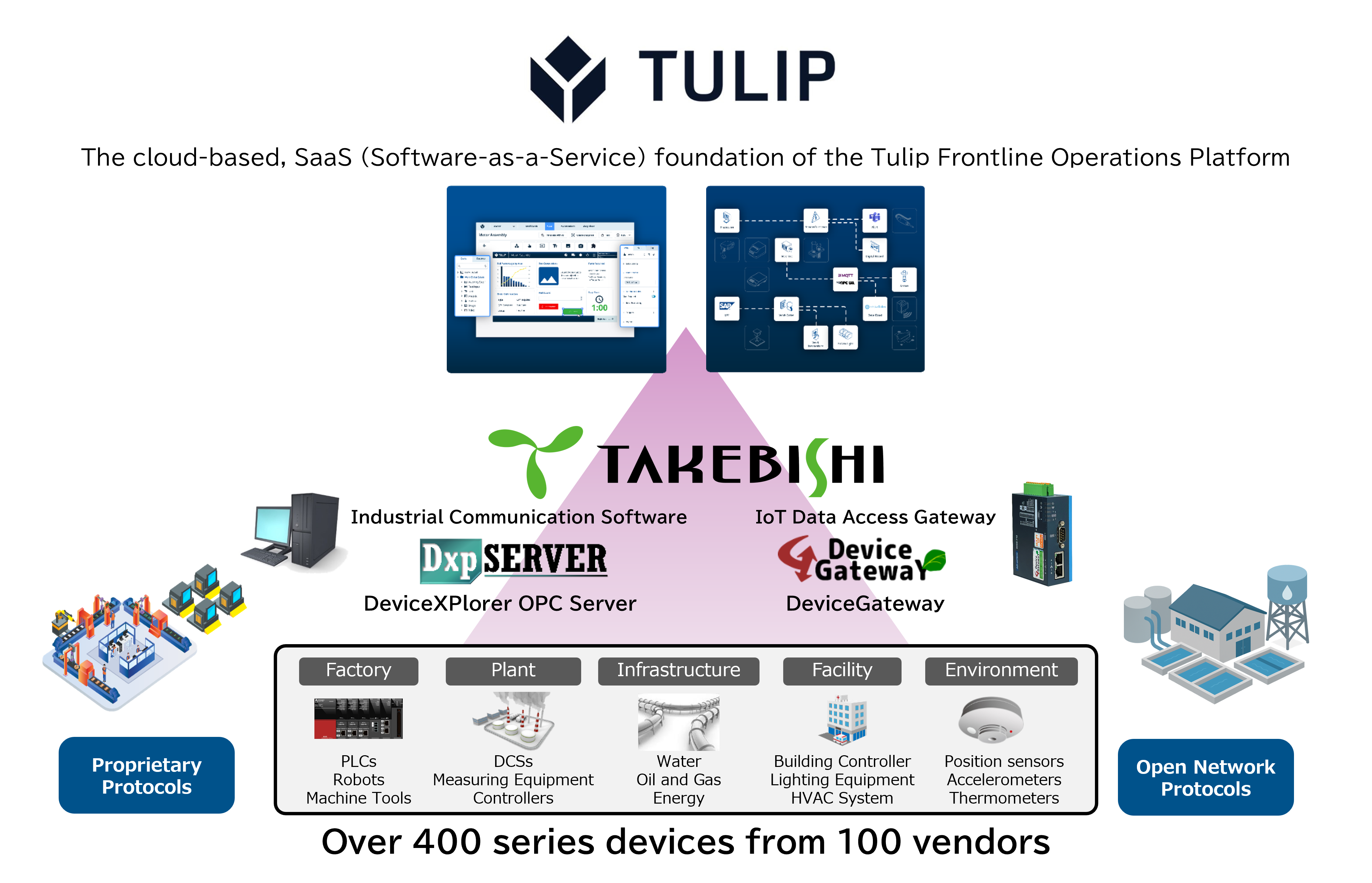
Figure 1: Conceptual view of Tulip Interfaces with Takebishi in a machine‑data workflow
Integration Configuration
Configuration image (conceptual)
Devices/PLCs → native protocols → Takebishi OPC layer (DeviceXPlorer OPC Server / DeviceGateway) → OPC UA (and/or MQTT) → Tulip via OPCH
Points
- DeviceXPlorer OPC Server runs on Windows and can centrally manage large and diverse equipment fleets and tag databases.
- DeviceGateway runs at the edge and is ideal for localized deployments close to machines or cells.
Each product’s detailed setup
-
Setup the OPC UA Server using either DeviceXPlorer OPC Server or DeviceGateway.
- Setup On-Premise Connector Host. Please refer to the On‑Premise Connector Host (OPCH) page on theTulip website.
-
Connect to the DeviceXPlorer OPC Server or DeviceGateway from Tulip. Please refer to the Build your first OPC UA data source page on theTulip website.
- DeviceXPlorer OPC Server Endpoint: opc.tcp://ipaddress:52250
- DeviceGateway Endpoint: opc.tcp://ipaddress:52220
Summary
By combining Tulip with Takebishi OPC solutions, you can digitize shop‑floor signals quickly and securely, accelerate IoT adoption across existing equipment, and connect data upstream for visualization and analysis, all without exposing OT systems to inbound internet traffic. This is an excellent first step toward a scalable, real‑time, data‑driven factory.
Products and Services Used
Takebishi:
Tulip: